
How do you set the monthly mileage limit correctly for a long-term car lease?
If you’re considering a long-term car lease, one of the most important considerations is setting the monthly mileage limit correctly. The number of kilometers driven directly affects both the monthly lease payment and the total cost over the lease term. Many drivers choose a limit based on an estimate, but setting it incorrectly can result in paying more than necessary or, conversely, having to pay extra for kilometers driven beyond the agreed-upon limit.

At AVIS Maxirent, you can choose the mileage package that best suits your driving habits. Whether you drive mainly in the city, commute to work regularly, or use the car for business trips throughout Slovakia, a properly set mileage limit will help you optimize costs and avoid unpleasant surprises at the end of the rental period.
In this article, you’ll learn how to set your monthly mileage limit correctly, which package is suitable for different types of drivers, what happens if you exceed the limit, and how the surcharge for extra kilometers works with long-term car rentals.
Why Is a Monthly Mileage Limit Important for Long-Term Car Leases?
For long-term car rentals, the rental price
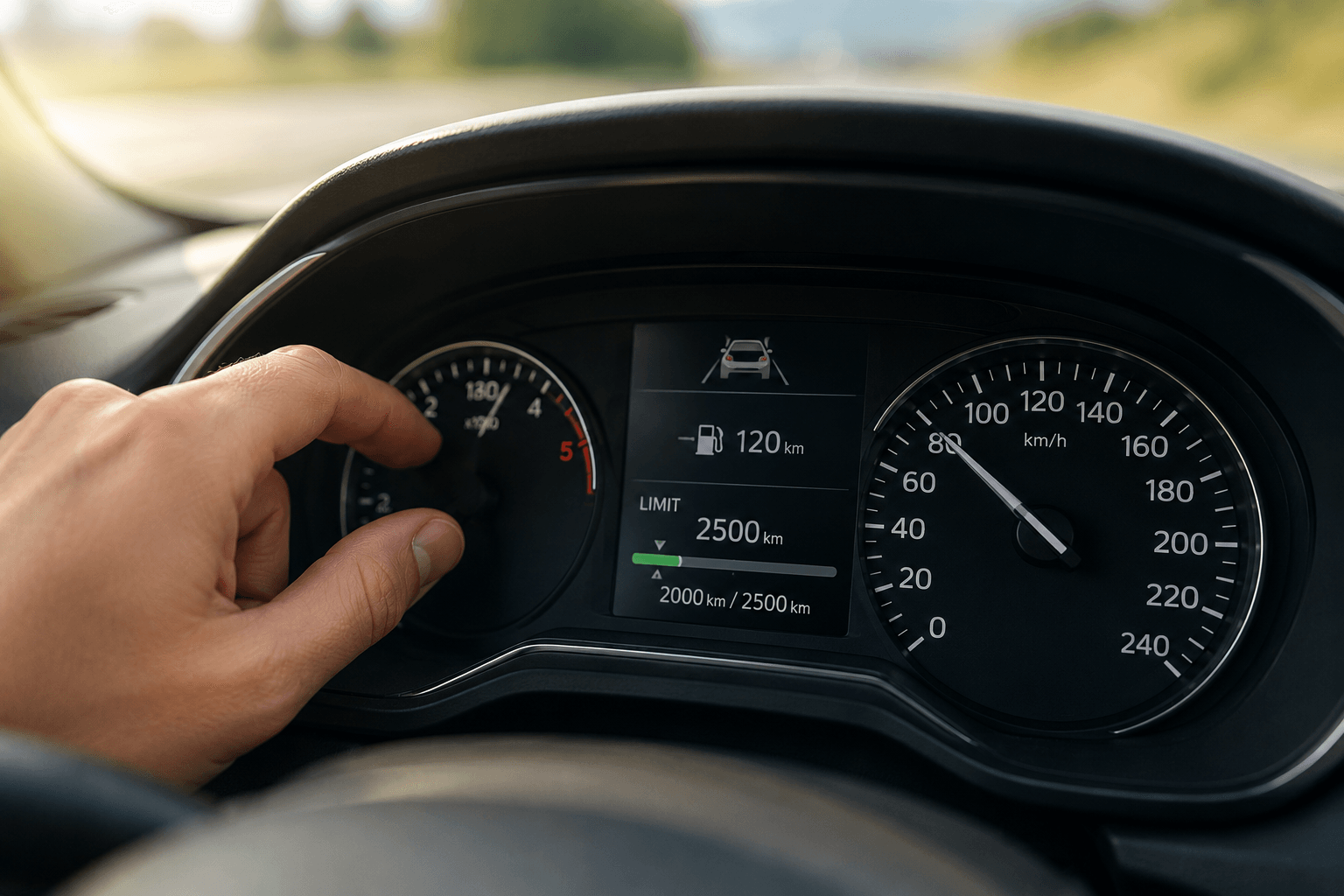
is also calculated based on the expected wear and tear on the car. The more kilometers the vehicle travels during the lease, the higher the costs for service, maintenance, tires, and its residual value.
A properly set limit offers several advantages:
- you pay only for the kilometers you actually need,
- you avoid an unnecessarily high monthly rental fee,
- you minimize the risk of additional charges at the end of the lease,
- you can more easily plan both business and personal expenses.
That’s exactly why it’s worth spending a few extra minutes choosing the right mileage package.
How do you estimate the right monthly mileage limit?
Check your driving history
The easiest way is to check the mileage on your current vehicle.
Calculate the average:
Total kilometers driven over the past year ÷ 12 = average monthly mileage.
For example, if you drive approximately 30,000 km per year, your monthly average is approximately 2,500 km.
Also consider future changes
When planning, take the following into account:
- a change in employment,
- more frequent business trips,
- moving,
- new business activities,
- planned road trips,
- business expansion.
It’s important to look ahead, not just at the current situation.
When is a 1,000-km monthly limit appropriate?
A 1,000 km monthly limit is ideal for drivers who use their vehicle primarily for shorter trips.
Typically, this includes:
- commuting to work within the city,
- shopping,
- leisure activities,
- occasional weekend trips.
An annual mileage of approximately 12,000 km is sufficient for most private users who drive less frequently.
Who is the 2,000 km per month plan suitable for?
The 2,000 km per month limit is a very versatile option.
It is particularly suitable for:
- sales representatives,
- managers,
- entrepreneurs,
- self-employed individuals,
- companies with frequent business trips.
Annual mileage is approximately 24,000 km.
This package provides ample flexibility even for irregular business trips across Slovakia or to neighboring countries.
When is it worth choosing the 3,000 km per month plan?
This package will be appreciated by drivers who spend a large part of their workweek behind the wheel.
Most commonly, these include:
- sales representatives,
- service technicians,
- regional managers,
- companies that make regular trips throughout Slovakia.
Annual mileage is approximately 36,000 km.
When should you choose the 4,000 km per month limit?
The highest limit offered is intended for clients who use their vehicles intensively.
It is particularly suitable for:
- courier services,
- construction companies,
- technical teams,
- companies with long daily routes.
The annual mileage of approximately 48,000 km provides sufficient leeway even for heavily used vehicles.
What happens if the mileage limit is exceeded?
Many clients worry that exceeding the limit will result in a hefty fine. In reality, it’s a standard surcharge mechanism for every kilometer over the agreed-upon limit.
The amount of the surcharge depends on:
- the specific vehicle,
- the type of contract,
- the rental duration,
- the agreed-upon mileage package.
The price per kilometer over the limit is therefore not fixed and is always specified in the terms and conditions.
With AVIS Maxirent, the customer knows exactly under what conditions they are using the vehicle and what costs may arise if they exceed the mileage limit.
Is it better to choose a higher limit or to pay extra?
There is no one-size-fits-all answer.
A simple rule of thumb can help.
If you expect to exceed the limit regularly every month, it’s usually more cost-effective to choose a higher mileage package when you sign the contract.
If it’s only for exceptional situations during the year—such as a single extended vacation or a few extra business trips—paying the surcharge for a few hundred kilometers is often more economical.
That’s why it’s worth estimating your actual vehicle usage.
How can AVIS Maxirent help you choose the right mileage limit?
One of the advantages of long-term rental with AVIS

Maxirent is the personalized approach to each client.
When selecting a vehicle, our experts will help you consider:
- your planned use of the car,
- your type of business,
- expected annual mileage,
- your budget,
- the lease term.
This ensures you get a solution that meets your actual needs without unnecessary costs.
A properly set mileage limit means better financial planning throughout the entire lease term.
Conclusion
Setting the monthly mileage limit correctly is one of the most important decisions when leasing a vehicle long-term. It’s not just a matter of the monthly lease payment, but also of the total costs over the entire period of vehicle use.
If you’re unsure which mileage package is best for you, it’s worth consulting with experts. AVIS Maxirent helps clients choose a solution that matches their actual driving habits and ensures an optimal balance between flexibility and cost.
FAQ
How many kilometers does the average driver travel per month?
Most drivers in Slovakia drive approximately 1,000 to 2,000 kilometers per month, though this depends on how the vehicle is used.
Can I exceed the agreed-upon limit during the rental period?
Yes. If you exceed the limit, a surcharge will be applied for each kilometer over the agreed-upon limit, in accordance with the terms of the contract.
How much does each kilometer over the limit cost?
The price per extra kilometer is not fixed. It depends on the type of vehicle, the rental period, and the terms of the specific contract.
Is it better to choose a higher mileage package?
If you expect to regularly exceed the limit, a higher mileage package is usually the more economical solution.
Is it possible to estimate the mileage limit accurately?
Yes. It’s best to base your estimate on the number of kilometers driven over the past 12 months and take into account any planned changes in how you’ll use the vehicle.